
The New Era of


The world is changing. Fast. For decades, how have we defined genius? Have we defined genius by the speed and breadth of a person’s knowledge—the human encyclopedia, the rapid-fire processor of facts. If you could hold more information in your head or analyze a dataset faster than anyone else, you may have been the intellectual elite.
That era is may be over.
We are now living in a new age where the world’s knowledge is accessible, and artificial intelligence can process, analyze, and synthesize data at a superhuman scale. The human brain, a magnificent organ, is simply not the best tool for sheer data processing anymore.
This is not a threat; it is an incredible opportunity that redefines what it means to be a genius. Plus, we can know that everyone has a seat at the data and AI table.
From Knowledge Keeper to Question Architect
The new era of genius may be a shift the focus from knowing to asking and creating.
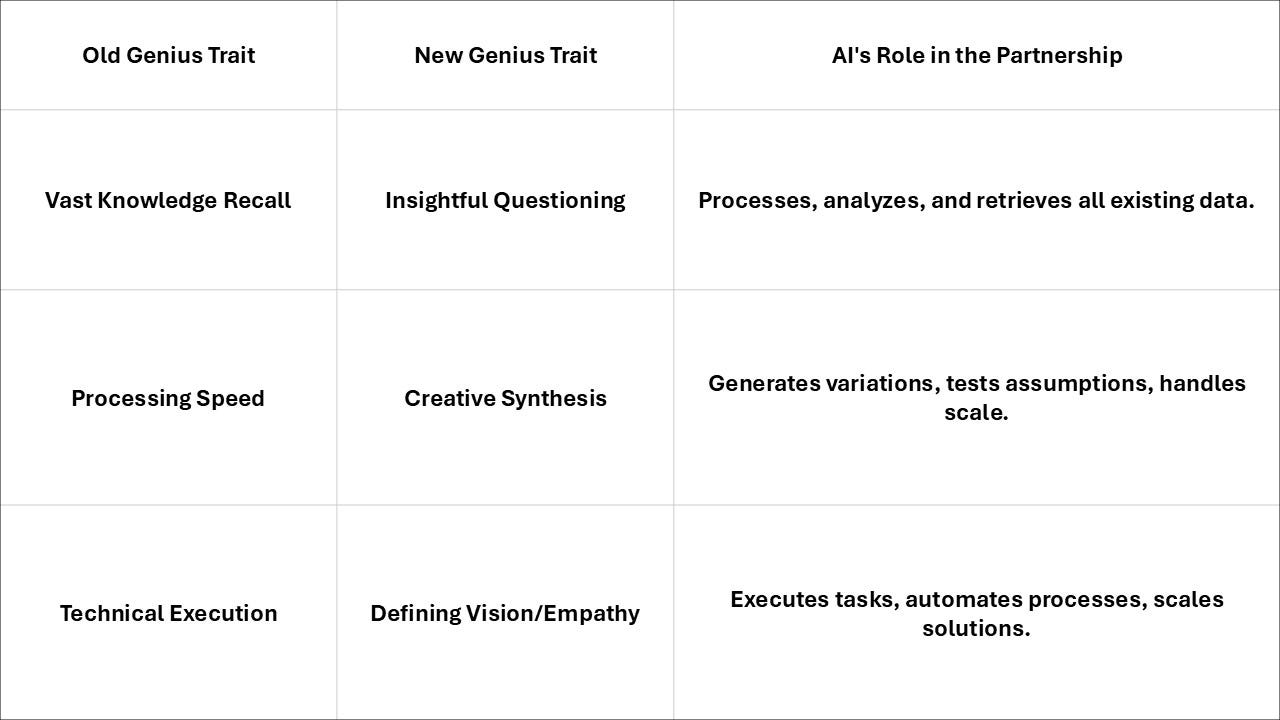
If AI is a perfect student with a memory for every textbook, creative, visionary, and bringing things to life that may not happen otherwise, then the new genius is the master architect of the question.
The true value is no longer in possessing the answer but in formulating the insightful question that unlocks a breakthrough. The knowledge is ubiquitous; the insight is available. The genius of the future is the person who can look at a problem, not with an aim to retrieve a known solution, but to craft a prompt or pose an inquiry that forces the AI—and themselves—to explore entirely new territory or create or to help us make better decisions.
The AI Partnership: Where Creativity Meets Scale
This shift has one part that is about partnership. The partnership between us as humans and the AI. My formula of Data + AI + IQ + EQ = Engineered Intelligence may be the way to think of it; two parts tech, two parts human. The new genius doesn’t work against the machine but with it.
AI handles the scale: The research, the analysis of millions of data points, the rote coding, the summarizing of dense documents.
The human provides the spark: The lateral thinking, the unique perspective, the empathy, the ethical consideration, and, most importantly, the creative leap.
Your place at the data and AI table is not as a competitor but as a co-creator. Think of it as a musical duo: AI can play every note, but you, the human, write the melody that makes people feel something. You define the direction. You establish the why. This is where true human value—creativity, ethical judgment, and critical questioning—becomes priceless.
How to Forge Your New Genius
To thrive in this new landscape, you need to actively cultivate the two skills that AI cannot yet master: creative questioning and profound creativity.
1. Master the Art of Questioning
A bad question gets you a generic answer. A great question leads to a revolution. To get better, focus on questions that challenge assumptions, not just ones that seek information.
Shift from “What” and “How” to “Why Not” and “What If”:
Instead of: “What is the most efficient way to market this product?”
Try: “Why haven’t we marketed this product using a medium that has historically failed our competitors, and what would have to be true for that to succeed?” (This challenges an assumption.)
Use AI for Questioning Prompts: If you’re stuck, ask your AI partner:
“I’m trying to solve X. Give me 10 questions that challenge the core assumptions of my current approach.”
“Generate five radically different, non-obvious metrics I could use to measure the success of project Y.”
Employ the “Five Whys” in Reverse: Instead of tracing a problem back to its root cause, trace a desired future state back to its necessary first step. Why must this happen? Why must the preceding step occur? This forces you to define a clear path.
2. Boost Creativity and Career Innovation with AI
Your career success will increasingly be tied to your ability to generate truly novel ideas, not just efficiently execute existing ones.
AI as a Creative Catalyst: Use AI to generate a volume of ideas you couldn’t achieve alone, and then use your human judgment to select, combine, and refine them.
Prompting for Divergence: “Generate 20 ideas for a new business in the education sector, but categorize them based on a random, unrelated field (e.g., circus performance, deep-sea exploration, ancient history).” This forces your thinking out of its usual rut.
The Creative Combo: Take two unrelated ideas generated by the AI and ask yourself: “How could I combine the core mechanism of Idea A with the market of Idea B?” The creativity is in the unexpected synthesis.
Build a “Creative Sandbox” into Your Workflow: Dedicate 10-15% of your professional time—daily or weekly—to playing with AI outside of your core tasks. Ask it to generate a persona for a potential future customer, draft a satirical memo about a business practice, or write a poem about your current challenge. This low-stakes play strengthens your creative muscle and your ability to craft effective prompts.
Focus on the Human Layer: Always ask: “What is the human problem this AI-driven solution is solving?” The new genius brings empathy and purpose to the table. AI can build the fastest bridge, but only you can decide which communities it should connect and why.
The new ear of genius is not a threat to your career; it is the democratization of genius. You no longer need a lifetime of rote memorization or an institutional pedigree to contribute to a breakthrough. All you need is curiosity, a healthy dose of creativity, and the skill to direct the most powerful tool humanity has ever built. My 3 Cs of data literacy are curiosity, creativity, and critical thinking. Two of them are mentioned in this paragraph, but don’t forget to workout and critically think on things. Don’t just take the prompt response at face value. Is it real? A hallucination? Does the response work for me?
Your place at the table is secured by your unique human perspective. Stop trying to compete with the machine, and start flexing your human superpower: you.