
Building Your Career Anchor
How to Build a Career Vision that Doesn't Shift with the Chaos

We are living through an era of unprecedented noise. What’s real and what’s not? Our ability to discern is being hit but we can definitely still progress forward intelligently.
Every morning, we wake up to a barrage of algorithmic updates, shifting political landscapes, a global mental health crisis, and technology evolving so fast it feels like the ground beneath our feet is made of sand. Now, growing up, I may have felt quick sand would be a bigger deal but, not sure I have ever encountered it. Our attention is no longer just requested; it is hijacked. It’s entirely natural to feel overwhelmed, reactive, and a bit adrift in the chaos.
When everything around us is changing at incredible speed, the human instinct is to focus outward—to constantly pivot, to react to the latest headline, or to chase the newest trend just to stay afloat.
But the secret to surviving and thriving right now isn’t out-maneuvering the external world. It is anchoring yourself from within. Ask yourself: do you have a personal anchor? Do you have your compass? What is guiding you forward?
To build a meaningful career in an age of overwhelm, our mindset may be our biggest ally. Our map providing the way. Our personal career vision and a deeply defined purpose empowering us forward in the chaos. Now, this can also lead to “new years resolution” syndrome: excitement to get going but falling off over time. How do we remain strong and secure in our vision, mindset, and purpose? Let’s look at some things you can do to build your personal career vision and purpose:
1. Mute the Noise to Find Your Core
You cannot define your purpose while the world is screaming in your ear. The first step in crafting a career vision is radical subtraction. Think about your day: how much of it is behind a screen somehow: laptop, TV, phone? How much time do we spend with our life dictated a few feet from our nose?
Purpose isn’t something you invent; it’s something you uncover. It lives at the intersection of three fundamental questions:
What are my non-negotiable values? (What matters to me when the title and the paycheck are stripped away?)
What problems do I actually care about solving? (Look past the buzzwords—what real-world friction bothers you enough to fix it?)
Where do my unique strengths meet the world’s needs?
The Action Step: Block out two hours this week. No phone, no laptop, no notifications. Write down the moments in your career where you felt most alive and impactful. What was the common thread? That thread is the beginning of your purpose.
By turning the screens off and by reflecting, and I mean turn the screens off and reflect, you may find things you didn’t remember about yourself.
2. Shift from a “Title” Mindset to an “Impact” Mindset
For decades, career planning was linear: you climb the ladder from Analyst to Manager to Director to VP. But in a world where entire job categories can be redefined by technology in a matter of months, anchoring your identity to a static corporate title is a massive risk. I mean, is going after a title what you really want? Or, would you lose sight of what makes you, you?
Instead, define your vision by the impact you want to make and the capabilities you want to master.
Old Vision: “I want to be a Chief Marketing Officer by 2030.”
New Vision: “I want to be a master storyteller who leverages emerging tech to humanize complex ideas and drive business growth.”
Titles can be eliminated overnight. A deeply ingrained capability and a clear sense of impact cannot.
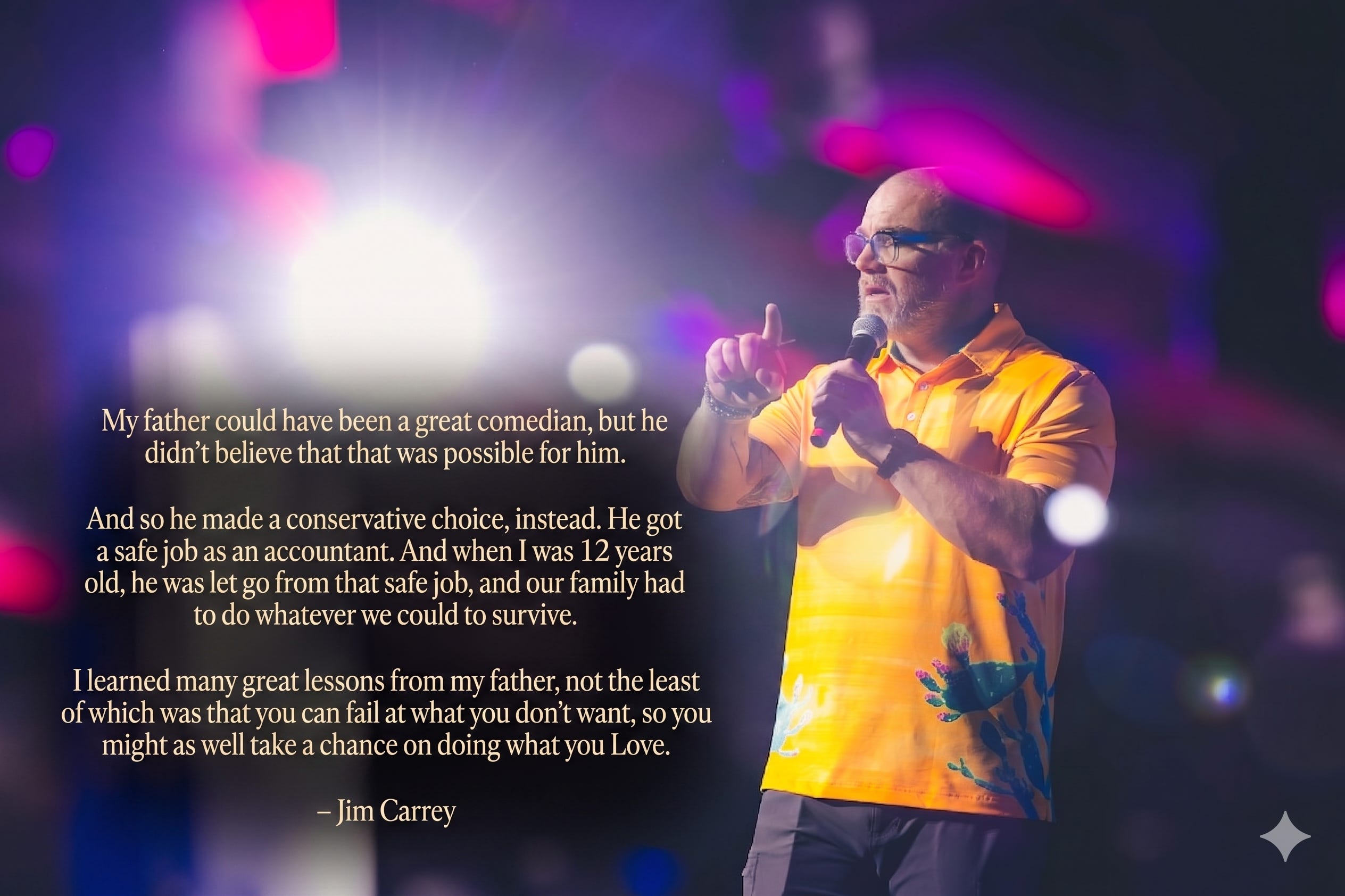
Jim Carrey has a story we should listen to:
“My father could have been a great comedian, but he didn’t believe that that was possible for him.
And so he made a conservative choice, instead. He got a safe job as an accountant. And when I was 12 years old, he was let go from that safe job, and our family had to do whatever we could to survive.
I learned many great lessons from my father, not the least of which was that you can fail at what you don’t want, so you might as well take a chance on doing what you Love.”
3. Draft Your Personal Career Manifesto
Once you have clarity on your purpose and impact, put it in writing. This isn’t a traditional resume summary or a corporate mission statement filled with empty buzzwords. This is a personal manifesto—a declaration of who you are, what you stand for, and where you are heading.
A strong career vision statement should be:
Aspirational yet Grounded: It should stretch you, but be rooted in your authentic strengths.
Future-Proof: It should be broad enough to survive technological shifts, but specific enough to guide your daily decisions.
An Filter for “No”: If a new opportunity, project, or role doesn’t align with this statement, it is a distraction.
4. Protect Your Attention
A vision without execution is just a daydream, and execution requires focus. In a world designed to hijack your attention, protecting your focus is an act of rebellion. How often do you track your work? How often do you plan a day and hold personal time sacred? Or, do we find ourselves picking up the phone and distracting ourselves with scrolling?
When you have a clear career vision, you no longer have to worry about missing out on every single macro-trend. You can look at the changing world through a very specific lens: Does this tool, this skill, or this change serve my ultimate purpose? If yes, lean in. If no, let it go.
The Anchor in the Chaos
The pace of change isn’t going to slow down. If anything, the technological and cultural shifts we are experiencing will only accelerate.
But remember: Change is only a threat if you don’t know who you are.
When you anchor yourself to a distinct purpose and a clear personal vision, the chaos stops being a storm that threatens to drown you. Instead, it becomes a current you can navigate. Take back your attention, define your core, and build a career that belongs entirely to you.
What is one core value that anchors your career right now? Leave a comment and let us know what helps you to feel anchored.
These are excellent lessons and I especially appreciated the first on muting the noise. There is not just more clarity, but also satisfaction and empowerment when *we* decide what we want to spend our time on (instead of letting algorithms decide for us).